


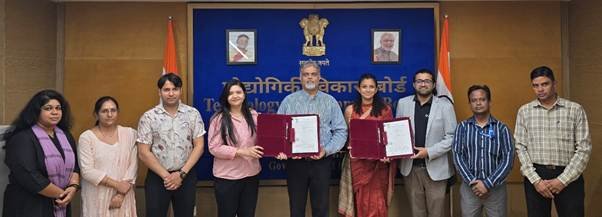
The Technology Development Board (TDB) enters into an agreement with M/s Griva Healthcare Pvt. Ltd., Vishakhapatnam to support the manufacturing and commercialization of ‘GrivaVision’, a portable digital colposcope with AI-assisted capabilities for early detection of cervical pre-cancerous lesions. With this support, the company plans to establish manufacturing capabilities at Kollam, Kerala.

The product is classified as a Class B non-invasive medical device and carries a CDSCO Class B manufacturing licence. It is being developed in accordance with ISO 13485 quality standards. The hardware architecture is proprietary and has been patented in India by Griva Healthcare. The company is presently undertaking its R&D activities at AIC-AMTZ Medivalley, Visakhapatnam, with the TDB-supported project enabling transition towards commercial manufacturing at its upcoming facility in Kerala.
GrivaVision integrates a high-definition camera, in-built display, user-friendly interface, advanced optics, and indigenous AI-enabled software into a portable diagnostic platform. Designed for visualization of the vaginal canal and examination of cervical lesions, the system assists gynaecologists in identifying pre-cancerous abnormalities during routine clinical examinations.
The technology is designed in accordance with WHO-approved Automated Visual Evaluation (AVE) standards and its software is ABDM-compliant, enabling integration with India's evolving digital health ecosystem. The system's key feature is its focus on indigenous development and localization. More than 50% of product components are currently sourced indigenously.
The technology assumes particular relevance considering the large population of women eligible for cervical cancer screening in India. By combining portability, digital imaging, AI-assisted assessment, and ease of deployment, GrivaVision has the potential to extend screening beyond specialized healthcare facilities and support healthcare professionals in reaching women in underserved and resource-constrained regions.
Source:
Press Information Bureau