


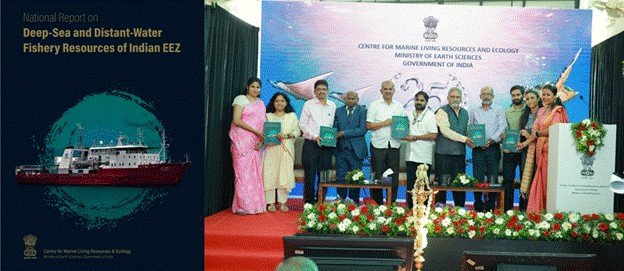
The Ministry of Earth Sciences has released a report detailing four decades of oceanographic research and systemic surveys across India's Exclusive Economic Zone (EEZ), offering a roadmap for sustainable development of the Blue Economy. The report provides findings on key deep-sea species, distant-water fisheries, and marine biodiversity hotspots.

The Ministry of Earth Sciences (MoES) has published a comprehensive report titled "National Report on Deep-Sea and Distant-Water Fishery Resources of the Indian EEZ". The document, released during the Silver Jubilee celebrations of the Centre for Marine Living Resources & Ecology (CMLRE), compiles nearly four decades of pioneering oceanographic research and three decades of systematic surveys across India's 2.37 million square kilometre Exclusive Economic Zone (EEZ).
Since the early 1990s, more than 400 oceanographic cruises have been conducted under the Marine Living Resources Programme (MLRP) aboard the Fishery and Oceanographic Research Vessel (FORV) Sagar Sampada. This floating laboratory carried multidisciplinary teams of scientists through grueling expeditions across various seas to map species distributions, estimate fish abundance, and capture critical environmental data.
Key highlights from the report include an assessment of living resources inhabiting the continental slope beyond 200 meters, substantial, currently underexploited stocks of deep-sea shrimps, perches, scombroids, flatfishes, and eels. The report also provides comprehensive data on high-value open-ocean and deep-water species such as tunas, billfishes, sharks, oceanic squids, and Antarctic krill.
Crucially, the publication documents ecologically vital regions that serve as nurseries and habitats for vulnerable ecosystems. Key areas highlighted include Kollam Bank & Angria Bank, Off-Mangalore Deep-Sea Slope, Terrace off Trivandrum, the Lakshadweep and Andaman-Nicobar Islands.
The report also emphasizes the transformative impact of modern technologies on Indian oceanography. By integrating fisheries acoustics, environmental DNA (eDNA), autonomous observing platforms, satellite observations, artificial intelligence (AI), and advanced ecosystem modelling, India is establishing a state-of-the-art framework for marine spatial planning.
Source:
Press Information Bureau