


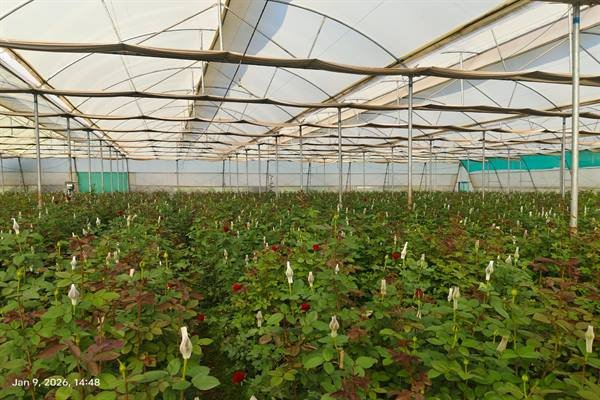
A village in Dhar district, previously reliant on traditional farming and vulnerable to unpredictable weather, has transitioned to high-value flower cultivation through modern protected techniques, boosting productivity and income, thanks to government support.

Located in Badnawar block of Dhar district, Rupakheda village once largely depended on conventional crops such as wheat, gram, maize, and soybean. Frequent unpredictable weather, limited earnings, and escalating cultivation costs posed substantial economic challenges to the majority of farmers, comprising approximately 391 households and a population of around 1,930. However, a turning point arrived with the introduction of protected cultivation techniques by the Department of Horticulture.
Through training, technical guidance, and awareness about government schemes, farmers in Rupakheda adopted polyhouse and shade-net farming and diversified into high-value horticulture. Today, the village boasts 44 polyhouses spread over approximately 144,407 square metres, where premium-quality flowers such as roses, gerberas, lilies, gypsophila, blue daisies, and white daisies are commercially cultivated. In addition, 13 shade-net houses covering nearly 42,000 square metres are utilized for the growth of improved varieties of vegetables.
Financial support from the Government of India's Mission for Integrated Development of Horticulture (MIDH) has been instrumental in this transformation. Under the scheme, farmers receive financial assistance of up to ₹19 lakh for each polyhouse unit and up to ₹14.20 lakh for each shade-net house, making modern protected cultivation more accessible.
Protected cultivation has not only increased productivity but also improved water-use efficiency, promoted balanced fertilizer application, strengthened pest and disease management, and ensured superior-quality produce. Improved packaging and better market linkages have further enabled farmers to realize higher returns.
Source:
MPInfo English News