


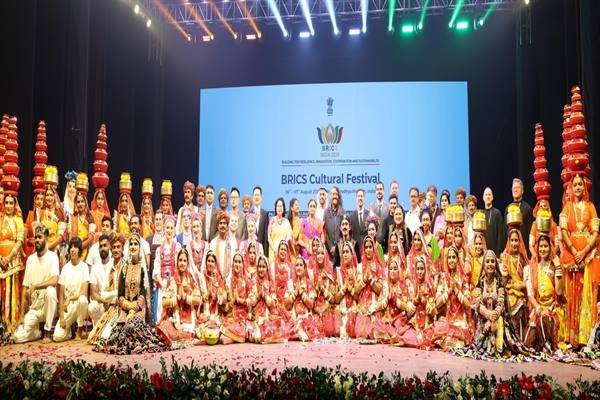
The Third Meeting of the BRICS Working Group on Culture saw a grand festival showcasing performances from Belarus, Brazil, Indonesia, Russia, UAE, and India during India's BRICS Presidency 2026.

On Thursday, in Bhopal, the Ministry of Culture, Government of India, organized the BRICS Cultural Festival 2026 as part of India's BRICS Presidency 2026. The event aligned with its theme — ‘Building for Resilience, Innovation, Cooperation and Continuity’.
The festival was held during the Third Meeting of the BRICS Working Group on Culture, aiming to strengthen the spirit of cultural exchange and mutual cooperation.
Inspired by India's civilisational philosophy of universal peace, harmony, and collective well-being, encapsulated in 'Sarve Bhavantu Sukhinah', the festival offered an important platform for promoting cultural exchange and fostering people-to-people ties among participating nations.
The programme commenced with a colourful cultural parade featuring delegations from Belarus, Brazil, Indonesia, Russia, the United Arab Emirates, and India. This grand procession symbolised global unity and cultural harmony.
Artists from the Gennady Tsitovich National Academic Folk Choir of Belarus captivated the audience with traditional Belarusian folk songs and lively folk dances. Brazil showcased Capoeira, an Afro-Brazilian tradition that uniquely blends martial arts, dance, music, and acrobatics.
Indonesia presented the traditional Balinese welcome dance ‘Pushpanjali’ followed by the renowned Javanese dance-drama ‘The Legend of Roro Jonggrang’, inspired by the Prambanan Temple. Soloists from the National Academic Folk Instruments Orchestra of Russia performed on traditional Russian instruments like the balalaika, bayan, alto domra, and contrabass balalaika.
Renowned Emirati musician Saif Al Ali represented the United Arab Emirates with a performance that blended traditional Emirati and Arab musical heritage with contemporary influences. Representing India, the cultural presentation ‘Maru Rang – Heritage of Rajasthan’ highlighted the rich folk traditions of Rajasthan through vibrant performances of Ghoomar, Chari, Kalbelia, and Bhavai dance forms.
The festival concluded with a grand finale bringing together artists from all participating countries on a single stage to celebrate cultural unity, mutual respect, and global harmony.
Source:
MPInfo English News